More than a Holiday – What India does to You
When people ask me what Good Food Journeys does, I often struggle to answer in a single sentence.
Are we a food tour company?
A cultural experience?
A luxury holiday?
The truth is, we are a little bit of all three.
Over the years, I have watched guests arrive in India with different expectations. Some come for the food. Some come for the history. Some come to hang out with Sid and Chand on the tours they host. Some come simply because India has always been on their bucket list.
What surprises me is that when they return home, the stories they tell are rarely about the monuments or even the meals.
They talk about the people they met, conversations they had and the moments they didn’t expect. Many still catch up with each other for an Indian meal in New Zealand years after the tour.
Recently, Chand Sahrawat, who will be hosting our tour in January 2027 (her fourth culinary journey to India with us), shared a reflection that perfectly captures why we keep taking people back to India. She shares why the chaos, colour and unpredictability of India can be one of life’s most transformative travel experiences:
I take Kiwis to India.
It’s one of the things I do that people find hardest to categorise.
Is it travel? Culture? Personal development?
It’s all of those things. And it’s something else too.
India has a way of dismantling you.
Not harshly. But completely.
You arrive with your usual frameworks, your efficiency, your planning, your sense of how things should go, and India looks at all of that and gently, insistently, refuses to cooperate.
Trains are late. Plans change. The unexpected becomes the itinerary.
And something interesting happens to founders in that environment.
They relax.
Not because everything is going smoothly.
But because they are finally, completely, out of control and the world doesn’t end.
One of the things I see in founder burnout is the exhausting belief that if they stop controlling, stop pushing, stop being the one who holds it all… everything will fall apart.
India disproves that theory in about 48 hours.
You surrender to the chaos, and you find, on the other side of it, a version of yourself that is lighter. More present. Less attached to outcomes that were never fully in your hands to begin with.
I bring people to India because I believe in what it does to the nervous system.
What it does to perspective.
What it does to the founder who has forgotten, somewhere in the relentless forward motion, how to just be in a place.
If you’ve ever felt like you need something that isn’t a strategy session or a meditation app, something that genuinely shifts something…
Come to India with me.
As a founder of Good Food Journeys, one of the privileges of leading tours is watching people change over the course of a journey.
Not dramatically, not overnight, but subtly over the course of the tour.
The business owner who spends every waking moment checking emails suddenly realises he hasn’t looked at his phone for hours.
The cautious eater who insists they don’t like spicy food finds themselves ordering seconds from a street-food stall.
The solo traveller who arrives knowing nobody leaves with a dozen new friends.
India has a way of slowing people down. Not because life moves slowly there – it doesn’t. In many ways, India is louder, faster and more chaotic than anywhere else on earth.
Yet somehow it encourages people to stop trying to control every outcome and simply experience what’s in front of them.
I have seen guests laugh more. They become more curious and even engage with the hotel staff. I have seen a chef in the 5 Star luxury hotel write down a recipe of an Indian dish for a guest in our group.
And perhaps that’s the real gift of travelling to a place like India. Where though your expectations aren’t met in a certain way, they are exceeded in another way.
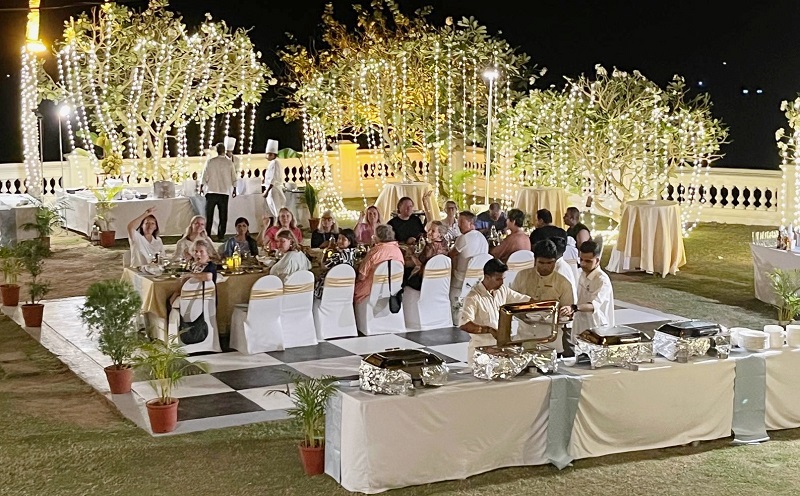
Like this photograph above taken on our tour in March which captures one of those moments – a group of strangers who, by this stage of the journey, had become friends, gathered around a table to share food, stories and laughter.
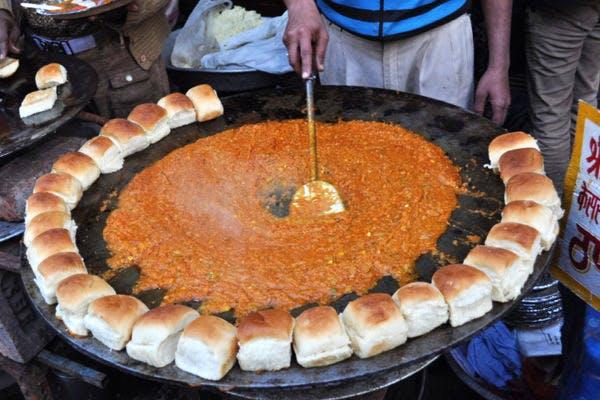
Every great dish tells a story. The one behind the Pav Bhaji is legendary.
Pav Bhaji is one of Mumbai’s most iconic street foods. It is a rich vegetable curry served with buttered bread rolls and loved by everyone from school children to business executives.
But Pav Bhaji wasn’t created in a restaurant. It was created out of necessity.
In the 1850s, Mumbai’s textile mills operated around the clock. Workers needed a meal that was quick, filling and inexpensive. Street vendors began mashing together leftover vegetables with spices to create a hearty curry that could be eaten quickly during short breaks. Soft bread rolls, introduced by Portuguese influences, were added as an accompaniment.
Today you will find countless versions across the country. It is available at a street side stall at midnight, on the menu of high-end restaurants plated to look good and made in millions of homes as a meal for the family. What began as a practical meal for mill workers has become one of India’s most beloved comfort foods.
Food is often the most delicious way to learn history.
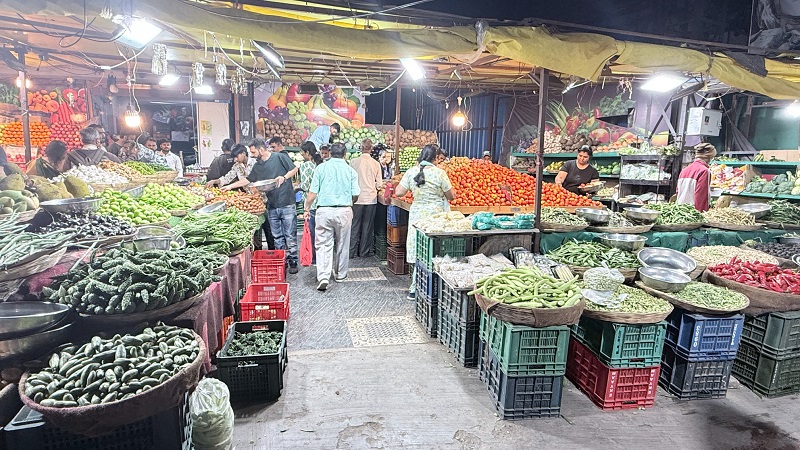
On my last trip to India earlier this year, I took this photo around 9 pm, just across the road from our home in Pune. It was January, the middle of the Indian winter.
This was just one of many street vendors still doing brisk business. Nearby were stalls selling fresh flowers for the next morning’s prayers, fruit and vegetables, and of course an endless array of street food buzzing with activity.
Standing there, I found myself reflecting on how different life feels in India compared to New Zealand. At 9 pm on a winter’s night in Auckland, most neighbourhoods are quiet and the streets are nearly empty. In Pune, the day is still very much alive.
Travel often teaches us the most when we pause and observe ordinary moments.
Sometimes the most memorable travel experiences come from doing nothing more than standing still and watching the world go by.
Warm regards,
Malhar
Good Food Journeys